
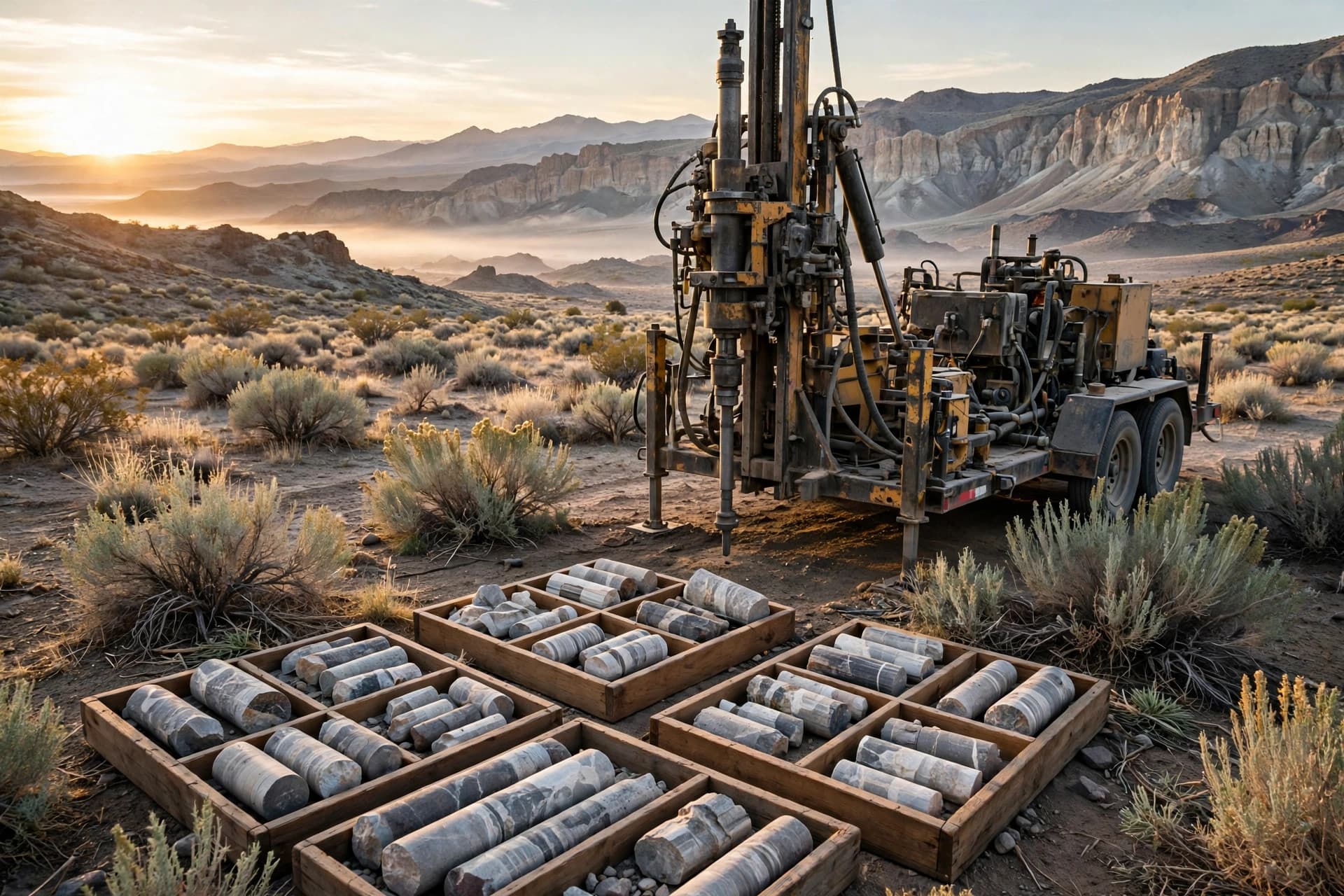
The first hole into a new corridor is supposed to tell you whether there is a system there at all. At Jake Creek, in Humboldt County, Nevada, Headwater Gold's first hole says there is: hole JC26-01 cut a broad run of gold in the Discovery Corridor, in the first drilling the project has seen under a partner-funded program.
- The headline intercept: 46.33 metres grading 1.34 g/t gold in hole JC26-01, starting at 277.98 metres downhole — the best drill result reported to date in the project area, the company says.
- The peak sample: 3.82 g/t gold over 1.52 metres, followed by a 2.29-metre interval of no core recovery (assigned a null grade in the composite) and then 0.76 metres at 3.13 g/t.
- The Jake Creek program: 3,574 metres in eight holes across five target areas, 100% funded by OceanaGold under its earn-in; assays from the second Discovery Corridor hole are still pending.
- Crane Creek, Idaho: Centerra Gold, as operator, completed about 2,780 metres in 18 holes (four core, 14 RC) between May and September — the first drilling there since the 1990s. Final gold assays have not yet been received.
- The ground: Jake Creek is 212 unpatented claims on BLM land, 65 kilometres northeast of Winnemucca and eight kilometres east of Nevada Gold Mines' Turquoise Ridge complex; a portion carries a 1% NSR, half purchasable for US$1,000,000.
- Next in Nevada: the self-funded scout program at the Whiskey project, announced October 20, is in preparation, with drilling anticipated in the coming weeks.
What the hole actually cut
JC26-01 was one of two holes drilled in the Discovery Corridor, and it provided the first core from that area. It encountered multiple silicified fault breccias and intervals of hydrothermal brecciation and quartz-carbonate veining with epithermal textures in the lower volcanic stratigraphy — the plumbing, in other words, that a low-sulfidation epithermal system needs.
The other six holes were widely spaced step-outs testing new structural targets across a kilometre-scale footprint beyond the corridor. All seven holes that reached volcanic stratigraphy confirmed the favourable host tuff unit and encountered epithermal alteration and veining, with elevated trace-element signatures the company reads as a broad hydrothermal cell extending well beyond the Discovery Corridor. One RC hole did not reach target depth in basin fill, and two others did not fully penetrate the host package. Headwater says it will publish a full breakdown once the remaining assays are in and integrated.
At Crane Creek, in western Idaho about 18 kilometres northeast of Weiser, Centerra's program followed up shallow historical mineralisation, tested beneath outcropping veins, and drilled deeper basalt-hosted structures that earlier, shallower drilling — which commonly stopped shortly after hitting the basalt — left untested. Drilling confirmed widespread silicification and alteration. None of that can be graded yet: the assays are the missing half of the story.
The partner picture
The same release carried a portfolio change. OceanaGold has terminated its earn-in agreements at Headwater's Hot Creek and TJ projects, after satisfying its minimum expenditure commitments at both — US$500,000 at Hot Creek and US$1,000,000 at TJ — without earning an ownership interest. Headwater retains 100% of both, describes Hot Creek as holding multiple drill-ready targets with a drill permit in place, and frames the decision as a realignment of OceanaGold's priorities away from greenfield work in new jurisdictions. The Jake Creek earn-in remains in effect; OceanaGold funded the completed program in full, and its decision on continued participation there is pending the outstanding assays.
The honesty box
The 46.33-metre interval is a downhole length; the company states the true thickness cannot be determined from the available information. Inside it sits a 2.29-metre interval with no core recovery that was assigned a null gold grade — its actual gold content is unknown, so the composite could be understated or the lost interval could be barren; the release is transparent about the treatment, and readers should be too. The six step-out holes returned no significant gold intercepts — alteration and trace elements are encouragement, not mineralisation. Crane Creek has no assays yet at all, and Jake Creek is an early-stage exploration project with no mineral resource estimate. Historical intercepts from 2010–2011 drilling quoted in the release are historical results, not current ones.
What to watch
The pending second Discovery Corridor hole and the remaining Jake Creek assays, OceanaGold's decision on Jake Creek once it reviews them, Centerra's Crane Creek assays, and the start of drilling at Whiskey.