
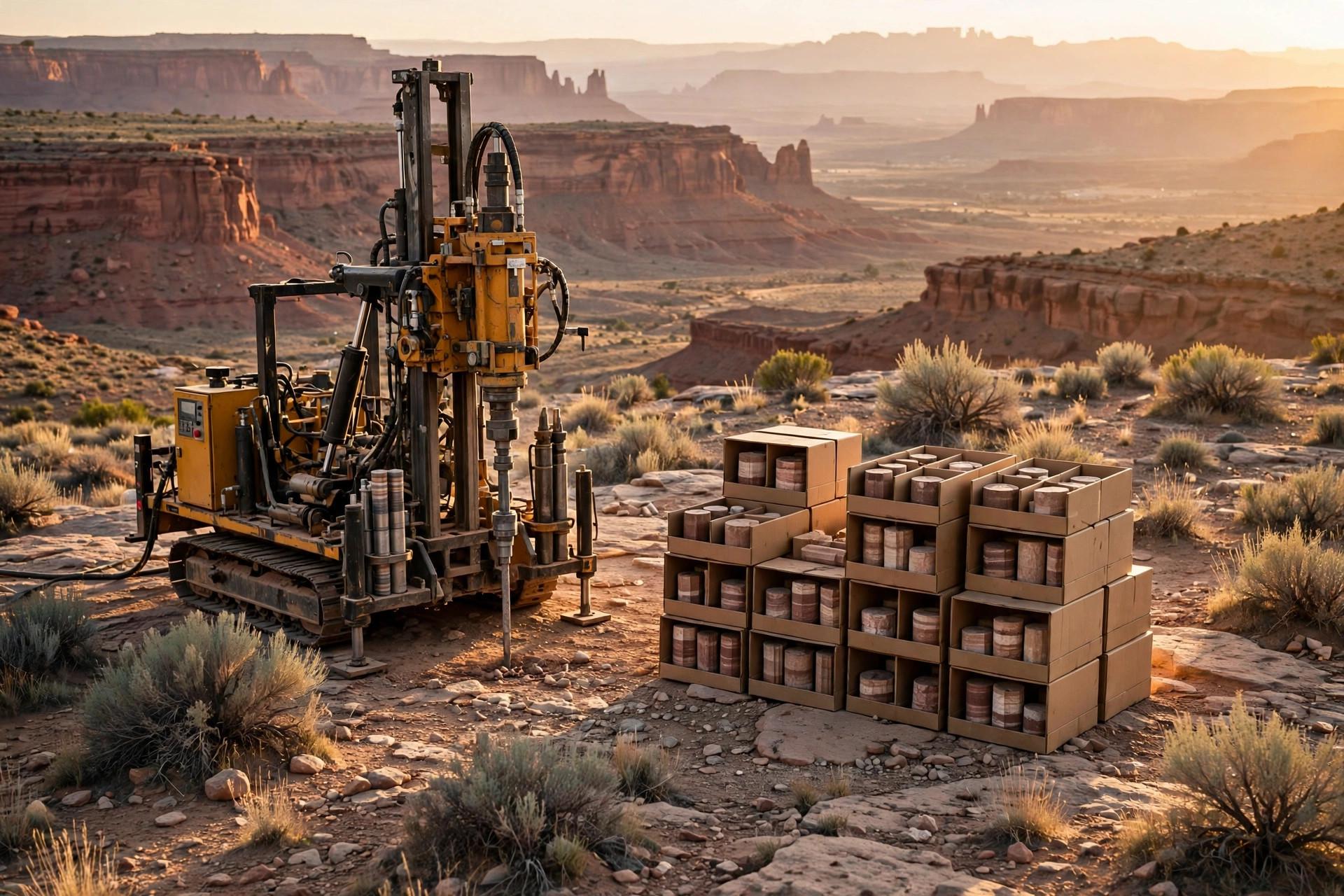
The final hole of a drill program usually answers the last question on the list. At Hawk Resources' Cactus Corridor in Utah, it opened a new one: DD26CT016, drilled at the northwestern end of the Cactus mine zone, was mineralised from the first metre. Hawk Resources Limited (ASX: HWK) reported the hole's assays on November 27, completing the results from its eleven-hole 2026 diamond program along the corridor.
- The headline hole: DD26CT016 cut 72.7 metres at 0.72% copper and 0.08 g/t gold from surface, including a higher-grade core of 26.7 metres at 1.51% copper, 0.17 g/t gold, 10 g/t silver and 0.022% molybdenum from 41.8 metres downhole. The company estimates the interval's true thickness at roughly 45–50 metres.
- The program scorecard: eight of the eleven holes drilled in 2026 (DD26CT006 through DD26CT016) encountered significant copper-gold-silver-molybdenum mineralisation, and assays have now been received for all eleven.
- The corridor: mineralisation is confirmed along roughly 500 metres of the 800–1,000-metre Cactus Corridor, which runs from the historical Comet deposit through the Cactus mine to the New Years prospect. A 300-metre drilling gap remains between the Cactus mine and New Years, and the corridor is still open to the northwest.
- The next steps, on the company's stated timetable: 3D modelling of the corridor mineralisation and design of the next drilling phase in Q4 2026, with follow-up drilling aimed at delineating an initial resource in H1 2027.
- The side news: Hawk is preparing a stream sediment sampling program of about 130 sites at its Meerkat copper-molybdenum project in Arizona, expected to start the week of November 30; and soil assays from its Olympus scandium project in Western Australia failed to confirm historical results, so no further work is planned there.
A corridor built on old mines
Cactus is not greenfield guesswork. The corridor threads a line of historical copper workings — Comet, Cactus, New Years — and Hawk's 2026 program was drilled at roughly 50-metre spacing to test whether the near-surface mineralisation those old mines left behind hangs together as one system under modern sampling and assay standards. Eight hits in eleven holes, capped by a from-surface intercept in the program's most northwestern hole, is the company's evidence that it does — so far.
The honest limits sit in the same release. The historical drilling Hawk is building on includes pre-JORC 2012 data that was not collected under modern quality assurance and quality control, and the company treats it as indicative of exploration potential only. The new intercepts are reported as downhole lengths; the 45–50-metre true-thickness estimate for DD26CT016 is an estimate, not a measurement.
The honesty box
There is no resource at Cactus yet. Hawk states plainly that the data is preliminary and insufficient to establish the continuity a Mineral Resource estimate requires — the H1 2027 initial resource is a target the next drilling phase is designed to test, not a figure that exists today. One wide hole at the corridor's northwestern end extends the system; it does not size it, and the 300-metre gap toward New Years is untested ground, not confirmed mineralisation. This post reports the November 27 announcement as issued.
What to watch
The Q4 2026 3D model and the design of the next Cactus drill phase; whether the H1 2027 program closes the 300-metre gap to New Years and converts intercepts into a first resource; and first results from the Meerkat stream sediment program in Arizona.