
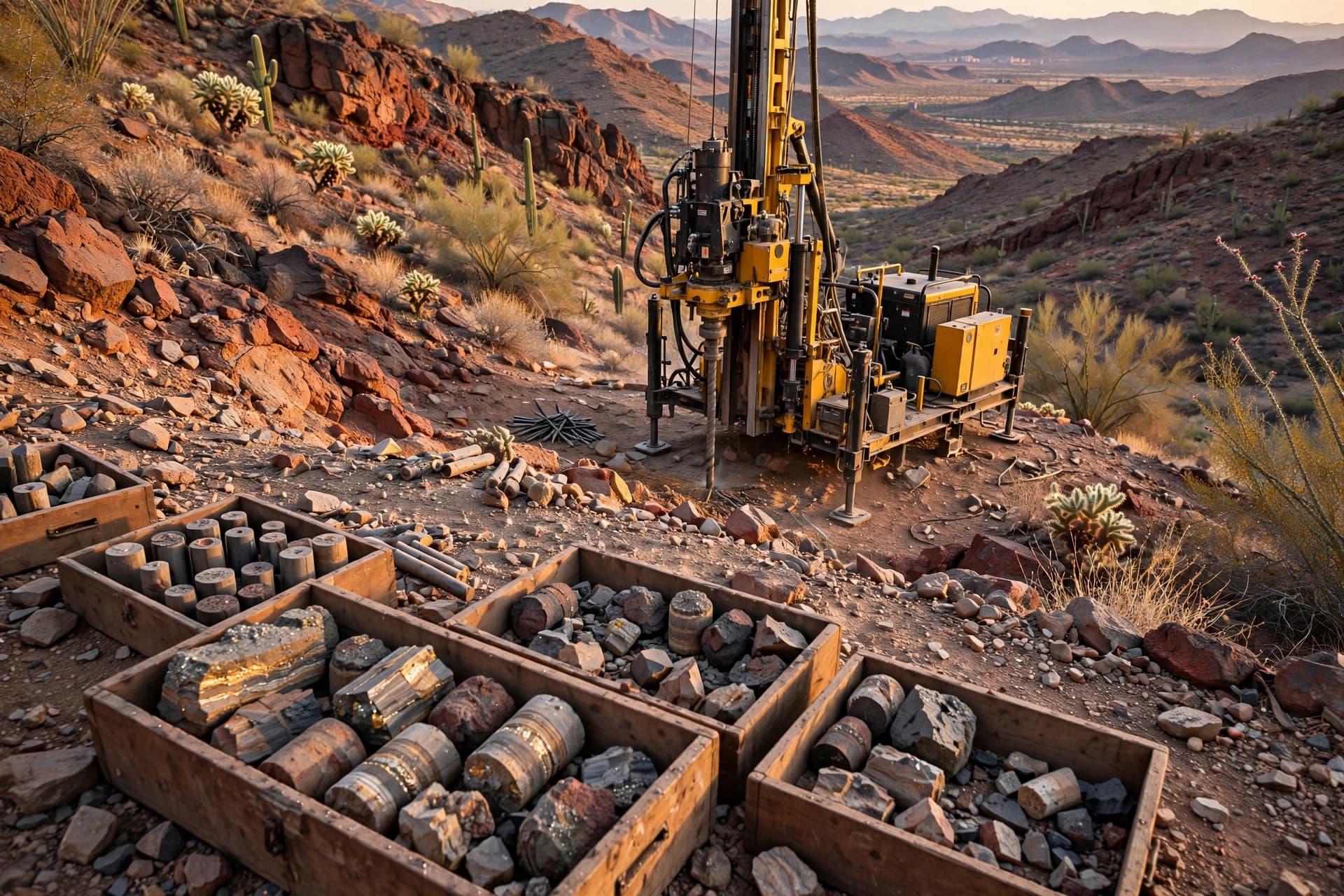
Southeast Arizona gold drilling just delivered the kind of continuity companies hope for heading into a resource update. On October 7, GMV Minerals Inc. (TSXV: GMV) reported completion of its 2026 diamond drill program at the Mexican Hat Gold project — 4,775 metres in 25 holes from 24 platforms, testing the deposit over 950 metres of strike and 370 metres of width.
- Every hole intersected significant gold mineralization within the established solids, with holes designed at angles greater than 75 degrees to cut true thickness. Notable assays include 12.64 g/t gold over 4.88 m in MHC26-14, 3.30 g/t over 12.39 m in MHC26-24, and 1.33 g/t over 29.57 m in MHC26-09.
- In total, 94 significant intervals exceeded the previous 0.2 g/t cut-off, averaging 0.87 g/t gold over 7.74 metres. GMV says drilling has now tested over 90% of the mineralization.
- The program's dual purpose was resource definition and geomechanical data for open-pit slope engineering — the unglamorous work that has to happen before any pit design holds up.
- MHC26-14 was described by the company as one of the highest gold intersections reported at Mexican Hat to date. The 25 new holes will feed a revised NI 43-101 Mineral Resource Estimate expected in the coming months.
- The last resource was compiled June 22, 2020, using a $1,375/oz gold base case — a price deck from a different era.
The system underneath
Mexican Hat is described as a structurally controlled metasomatic gold deposit hosted in Cenozoic volcanic and volcaniclastic rocks. GMV's model builds around seven zones tied to a principal controlling structure extending more than 1,500 metres, with six branch structures striking east-northeast for up to 450 metres.
Previous metallurgical testwork reported column-test gold recoveries up to 98%, and the company attributes part of that performance to limited silicification in the ore — a geological detail that matters if the project advances toward heap-leach evaluation.
One caveat, kept visible
These are drill intercepts, not reserves. The project's 2025 preliminary economic assessment is preliminary in nature and includes inferred mineral resources, which are considered too speculative geologically to be converted to reserves without further drilling and study. Mineral resources that are not mineral reserves do not have demonstrated economic viability.
That said, the sequencing is clean: complete the infill and definition drilling, refine the model, and publish an updated resource at today's price environment rather than 2020's. What the new estimate upgrades — and what stays inferred — is the next real data point for Mexican Hat.