
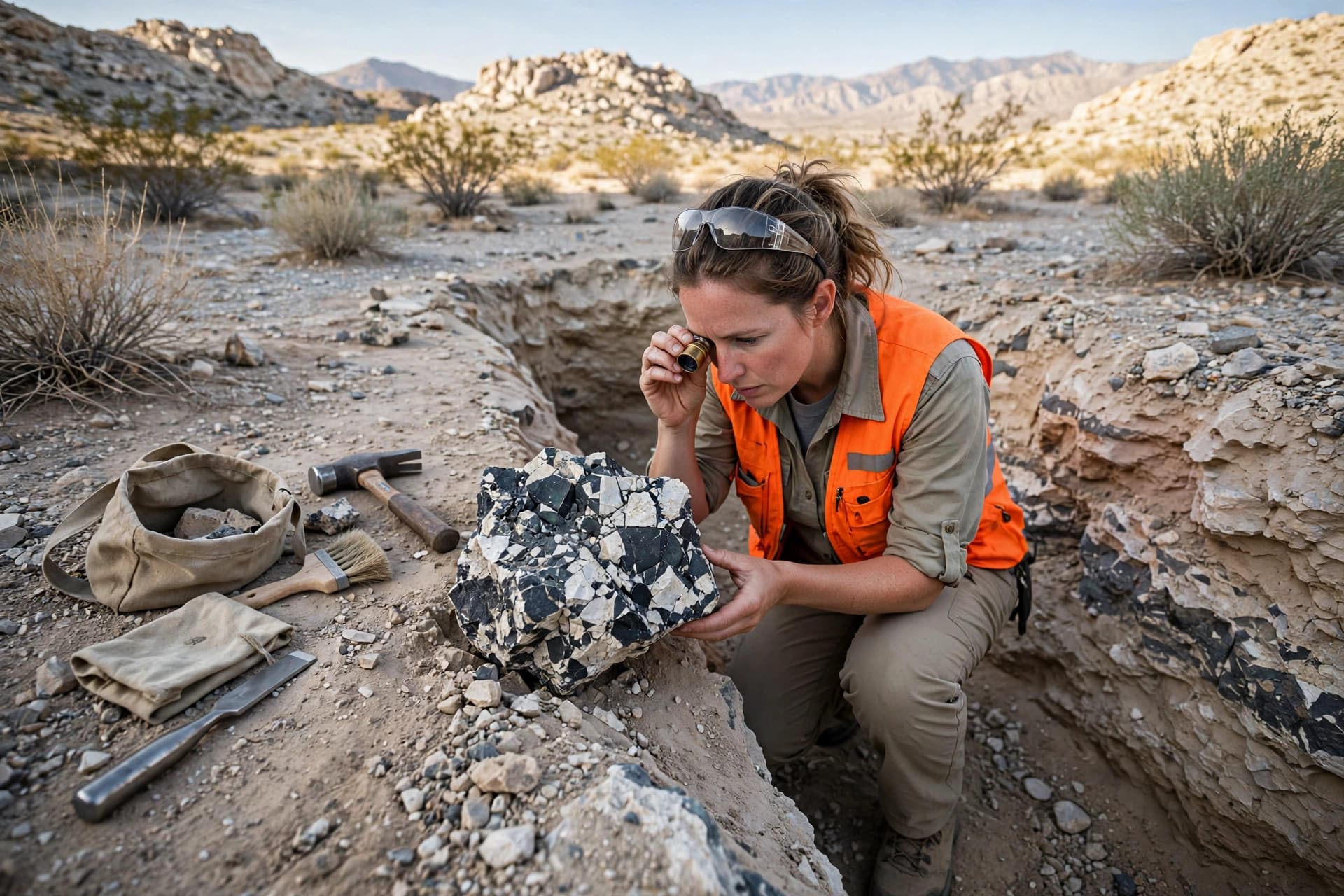
Most rare earth deposits lock their metals in hard minerals that take aggressive chemistry to crack. Globex's November 2 release from southeastern Nevada is interesting for the opposite claim — that at Gem Hills, the rare earths are mostly stuck to clays — and it arrives with a laboratory report, not just rock samples, to argue the point.
- Ground expanded: the contiguous Gem Hills claim block is now 20 unpatented lode claims — staked in October 2026, up from the 8 claims staked in October 2025 — totalling 167.22 hectares (8.36 hectares per claim) on BLM public land outside designated conservation areas, on the eastern flank of the Clover Mountains in Lincoln County, about 170 km northeast of Las Vegas.
- The footprint so far: mineralisation found in a 2024 regional prospecting campaign, outside any known mining district at the southeastern margin of the Caliente Caldera Complex; 2024–2025 sampling, trenching and dump sampling from 1930s workings confirmed an initial footprint along a 90-metre strike length, open to the north and south.
- Surface grades — historical sampling: of 34 property-wide rock samples from the autumn 2025 program and one 2024 sample, 18 returned 0.28% to 5.26% total rare earth oxides (TREO), averaging approximately 1.7% TREO. Heavy rare earth oxides averaged 8% of TREO (up to 19%).
- The synchrotron result: three powdered channel samples — 1.889% TREO over 0.60 m, 2.281% over 0.95 m and 2.642% over 1.75 m — were analysed by high-resolution synchrotron X-ray diffraction at beamline ID31 of the European Synchrotron Radiation Facility; the report was received October 19, 2026. The only discrete rare earth mineral detected was bastnaesite, in trace amounts up to 0.18%; more than 90% of the rare earths are adsorbed to nacrite, gibbsite and nordstrandite.
- Radioactivity: the release reports no uranium or thorium anomalies above normal background, with thorium below 20 ppm in initial geochemical sampling.
Why the mineralogy is the story
Ion-adsorption rare earth deposits — the kind mined in southern China — hold their metals loosely on clays, which is what makes them leachable with mild solutions. They are normally weathered, low-grade and light-rare-earth-poor in heavies. Globex's argument, built on the XRD mineralogy, is that Gem Hills formed differently: a multi-stage hydrothermal system at a faulted carbonate–volcanic contact created the high-temperature clay nacrite and the aluminium hydroxides gibbsite and nordstrandite, and the rare earths adsorbed onto them — a hydrothermal, not weathered, ion-adsorption system, with a heavy rare earth share the company puts at an average 8% of TREO.
Globex is a project generator: its stated near-term path is either a definitive option agreement with a partner to fund the next phases — systematic drilling and formal metallurgical bench testing — or work programs funded by Globex itself.
The honesty box
This is early-stage exploration, and the promotional language in the release should be read that way. There is no mineral resource estimate for Gem Hills, no drilling reported in this release, and no metallurgical recovery test work yet — the claim that clay-hosted rare earths "could be expected" to allow milder, cheaper leaching is expressly subject to additional detailed metallurgical test work and positive results. The grades quoted are surface rock, channel, trench and dump samples — selective samples that do not establish the grade or width of a deposit — over a confirmed footprint of just 90 metres. The "entirely new class of deposit" classification is the company's interpretation of three XRD samples, prepared under Qualified Person Jack Stoch, P.Geo.; phrases in the release such as "highly de-risked" and speculation about federal funding, forward purchases and price-floor guarantees are management belief, not commitments by any government agency.
What to watch
Whether Globex signs the option partner it is seeking; the first systematic drilling at Gem Hills, which would test whether the surface footprint continues at depth; and formal metallurgical bench testing — the work that would confirm or refute the leachability argument the synchrotron results have raised.