
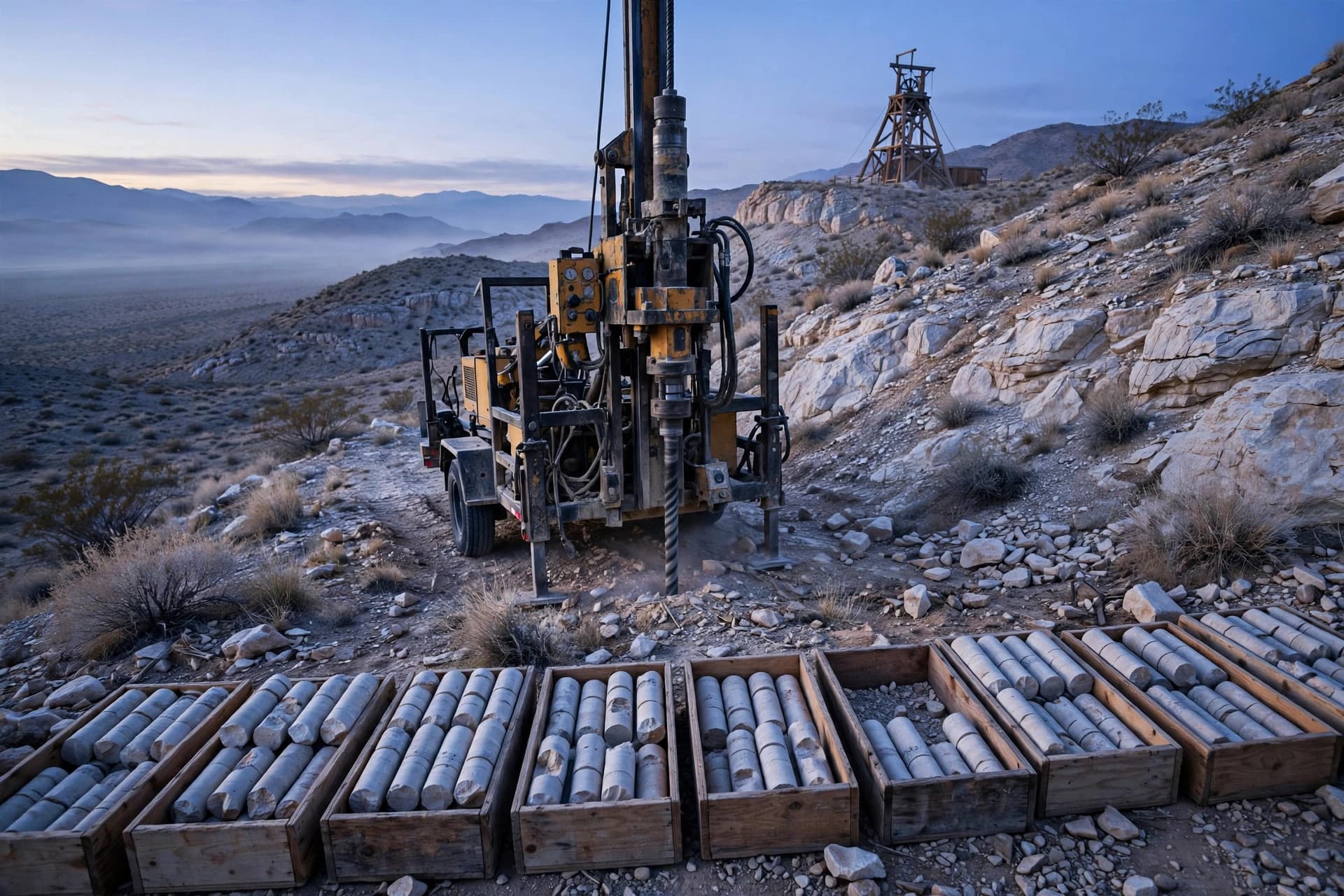
Follow-up drilling is underway at one of Nevada's historic high-grade gold camps. On October 8, G50 Corp. (ASX: G50) announced it had commenced diamond core drilling at the White Caps Gold Project in Nye County, testing continuity around its first modern core hole.
- The new holes step out roughly 100 metres laterally and up-dip from WCD26-01, the first core hole drilled at White Caps, which returned 13.5 m at 7.67 g/t gold including 3.93 m at 23.95 g/t gold in a decalcified, silicified limestone unit.
- The target is a discrete limestone horizon that can be traced along strike and up-dip — the program is designed to test whether grade and geology hold together beyond a single hole.
- White Caps is a historical high-grade gold mine previously drilled by Freeport-McMoRan in 1982–1984. G50 says this is the first systematic modern core testing of the mineralized limestone unit.
- Assays from remaining February core holes are still pending, so White Caps has two near-term data streams: outstanding results plus the new step-outs.
- G50 is also advancing the Golconda project in northwest Arizona (gold, silver and a reported gallium discovery) alongside White Caps.
A single good hole becomes a program
One high-grade intercept proves grade exists; it does not prove a deposit. The value of this program is geometric — if the limestone host and its decalcified, silicified alteration repeat at 100-metre step-outs, White Caps starts to look like a coherent system rather than an isolated hit near old workings.
White Caps sits near Scorpio Gold's Manhattan project in a district with a long production history, which helps with context and infrastructure but says nothing by itself about continuity at White Caps. That question belongs entirely to the new core.
One caveat, kept visible
Drill intercepts are downhole lengths from exploration drilling, not resources or reserves, and a follow-up program can narrow a target as easily as it expands one. Until step-out assays return and true widths are established, WCD26-01 remains exactly what it is: a strong first hole that now has to survive contact with its neighbours.