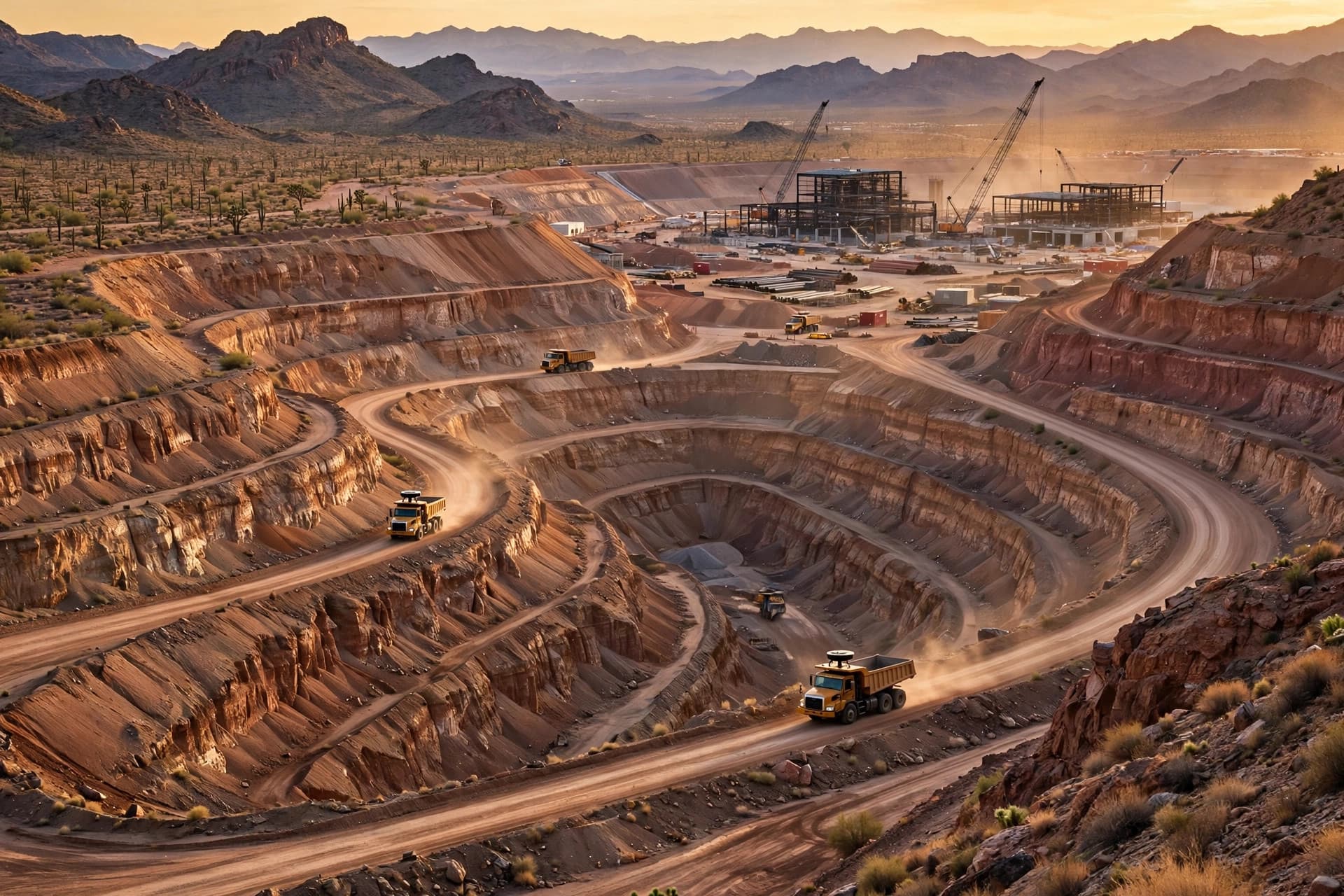
This is the biggest single copper decision announced in Arizona this year, and it is a brownfield one: no new mine, no new district — a mine that has run since 1945 getting a second, much larger life. Freeport (NYSE: FCX) announced that its board has approved a $4.5 billion expansion and modernization program for Bagdad, its wholly owned copper and molybdenum operation in northwest Arizona.
- The approval: a $4.5 billion expansion and modernization program, approved by Freeport's board of directors. Planned spending is classified as discretionary in the company's financial policy and will be folded into its updated capital outlook.
- The production change: annual long-term copper production rising to over 400 million pounds a year — an increment of approximately 225 million pounds a year — and molybdenum to over 20 million pounds a year, an increment of about 12 million pounds a year. The company says that positions Bagdad as the second-largest copper mine in the United States, behind Freeport's own Morenci, and a leading U.S. molybdenum producer.
- The build: a new concentrator providing approximately 115,000 metric tons per day of incremental nameplate processing capacity, plus a new primary crusher, overland conveyor, water pipeline, power line, mining equipment and related infrastructure — more than doubling Bagdad's mining and milling rates.
- The ground underneath it: a mineral reserve base the company puts at 2.6 billion metric tons of ore at a copper-equivalent grade of 0.43%, and a current reserve life exceeding 80 years before counting additional mineral resources.
- The money and the clock: approximately 20% of project costs in 2027, 30–35% in 2028, and the balance in 2029–2030; a construction period of approximately 3.5 years, with initial production targeted in mid-2030.
- The cost claim: an approximate 20% reduction in long-term unit net cash costs, attributed to economies of scale, technology and molybdenum by-product credits, and break-even economics the company says are supported at a copper price of approximately $4.00 per pound ($20 per pound molybdenum).
- Jobs: the company cites more than 4,000 direct and indirect jobs during construction and thousands of long-term employment opportunities for Arizona.
A mine that already automated, now scaling
Bagdad is not a struggling asset being rescued. It has operated since 1945, and in 2025 it completed its fleet conversion to become, in the company's telling, the first major U.S. mine with a fully autonomous haulage fleet. The expansion is designed to build on that base — established infrastructure, an experienced workforce and a well-known ore body — with modern technology and automation carried through the larger operation, including a fully autonomous truck fleet supporting the higher mining rates.
President and CEO Kathleen Quirk: "We are pleased to proceed with the Bagdad expansion, an important step in advancing Freeport's U.S. copper growth strategy. This low-risk brownfield project builds on Bagdad's substantial reserve base, long operating history, existing infrastructure and experienced workforce to deliver new U.S. copper and molybdenum production."
The honesty box
Every production, cost and timeline figure above is a forward-looking company statement, not a built plant: the $4.5 billion is an estimate based on current market conditions, and the release itself notes that inflation and cost escalation could move it. Initial production in mid-2030 is a target roughly three and a half years of construction away. What is factual today is narrower and still significant — a board approval, a defined scope (new concentrator, crusher, conveyor, water and power infrastructure), and a spending profile that starts in 2027. The 400-million-pound figure is a long-term annual rate once the expansion is complete and ramped, not Bagdad's current output.
What to watch
Inclusion of the Bagdad spending in Freeport's updated capital expenditure outlook; the start of engineering, procurement and early works the company says it is advancing now; and whether the 2027 spending share — about a fifth of $4.5 billion — lands on schedule, which is the first hard test of the mid-2030 target.