
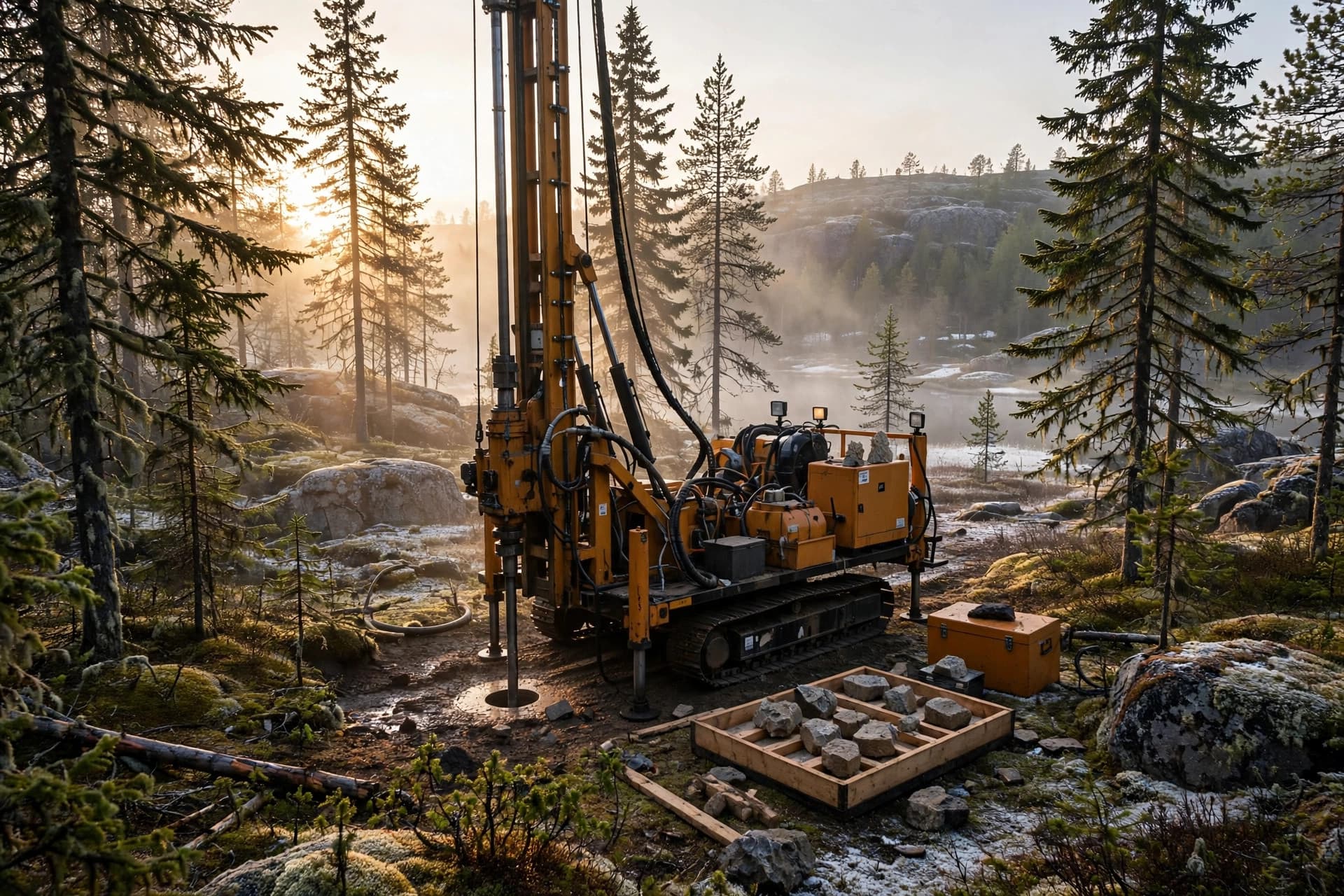
FireFox Gold has found a second gold story on its flagship Finnish ground. On September 16, the company announced the discovery of the Lammas Zone at its 100 percent owned Mustajärvi Gold Project in Lapland, Finland, with a first drill hole cutting 21 metres averaging 4.13 grams per tonne gold nearly a kilometre east of the main shear zone the company has been drilling since 2018.
- Discovery hole 26MJ032 cut 21.0 metres at 4.13 g/t gold from 114.0 metres downhole, including 1.0 metre at 21.6 g/t gold, plus a second interval of 4.2 metres at 3.41 g/t gold from 138.0 metres.
- The Lammas Zone sits roughly 750 to 950 metres east-southeast of the East Zone centre, nearly a kilometre east of the main Mustajärvi Shear Zone, and more than 650 metres from any previous drilling.
- Only one of three Lammas holes drilled so far has assays; the other two show pyrite-tourmaline veining but no visible gold, and the company cautions that the veining does not necessarily mean gold is there.
- FireFox is working toward a maiden resource estimate for Mustajärvi in early 2027, and Lammas is one of several new targets now getting first drill tests with a second rig on site.
What did FireFox Gold find at the Lammas Zone?
The discovery hole tested the strongest conductor plate from a fixed-loop electromagnetic (FLEM) survey, an interpreted splay, or branch, of the Mustajärvi Shear Zone along the regional Venejoki Shear Zone. After 13 metres of glacial sediments and a contact between ultramafic volcanic and metasedimentary rock at 86.8 metres, the hole hit broad stacked gold intervals beginning at 114 metres, associated with patchy and semi-massive pyrite in quartz-carbonate-tourmaline-pyrite veining inside intensely altered metasedimentary rock.
The full interval list, reported at a 0.3 g/t gold cut-off, includes the headline 21.0 metres at 4.13 g/t, with sub-intervals of 1.0 metre at 21.6 g/t, 1.0 metre at 9.58 g/t, and 2.0 metres at 8.3 g/t. Below a 3-metre internal waste section, another 4.2 metres averaged 3.41 g/t, including 1.0 metre at 7.22 g/t. Deeper narrow hits of 1.0 metre at 3.01 g/t (186 metres) and 1.0 metre at 1.82 g/t (191 metres) rounded out the hole. All intervals are expressed as core widths; true widths have not been estimated.
How did they find it?
Lammas was a geophysics-led discovery. FireFox ran detailed ground magnetics across most of the tenement and spotted structures with responses consistent with alteration along the main shear zone, then confirmed gold anomalies in base-of-till (BoT) sampling over the new target, sampling the bottom of the glacial till layer to sniff out mineralization hidden below. An electromagnetic survey returned conductors consistent with the high-pyrite, high-grade gold mineralization at the Northeast and East Zones, and the company moved quickly to drill three holes along roughly 250 metres of the northeast-striking structure.
FireFox's Finnish geophysicist and structural consultants confirm the mineralization carries the same quartz-tourmaline-pyrite alteration assemblage as the Northeast and East Zones, interpreted as a separate branch or splay within a broader mineralized corridor. That matters because it is common in orogenic gold systems, gold formed during mountain-building events along deep crustal structures, for mineralization to appear along multiple parallel structures, so Lammas suggests the Mustajärvi system is wider than one fault line.
What happens next?
Assays are pending for holes 26MJ033, collared about 60 metres southwest of the discovery hole, and 26MJ035, about 200 metres to the northeast. CEO Carl Löfberg said geophysics and BoT geochemistry suggest the structure could continue across the highway onto FireFox's northern block and eventually toward ground held by Agnico Eagle, more than a kilometre away, and the company plans to return to drilling in the coming weeks when winter conditions provide better access.
The bigger picture: Mustajärvi now has roughly 29,897 metres of drilling behind it across three gold lodes along more than two kilometres of strike, and the arrival of a second drill rig has let FireFox test targets beyond the main shear zone for the first time. A maiden resource estimate is targeted for early 2027, and the company held an investor webinar on September 18 with chairman Patrick Highsmith walking through the drilling. Highsmith, a certified professional geologist, is the qualified person on the technical disclosure.
Why does a second gold zone matter for Finland's gold story?
One hole does not make a mine, and only one of three Lammas holes has assays, but a high-grade gold hit on a parallel structure nearly a kilometre from the main trend is exactly how a gold camp grows: each new splay feeds the resource pipeline rather than just extending the old one. Finland remains underexplored for gold despite a strong mining law and long mining tradition, and FireFox has been exploring there since 2017 with a Finland-based team. Read the Finland master report for the country's broader gold picture, from its geology to the companies working it.