
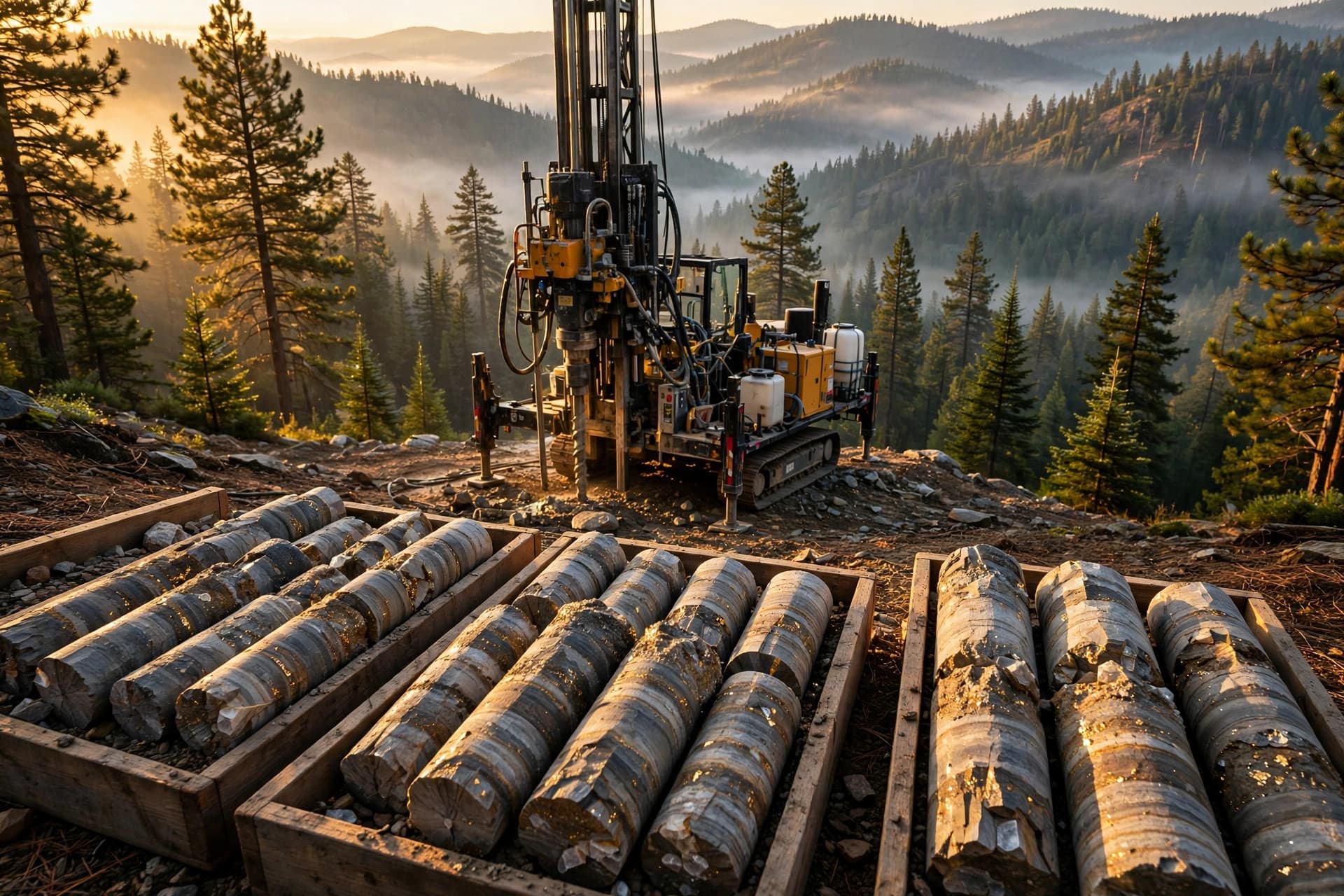
The first hole is the one that tells you whether the old-timers stopped too soon. At the Friday Gold Project in Idaho, Elk Range Mining's maiden diamond hole, 26FRD001, says they did: assays released October 27 show gold running roughly 170 metres deeper than the historical hole it was drilled beside.
- The headline envelope: 290.3 metres at 2.8 g/t gold (downhole), from the first to the last qualifying assay in hole 26FRD001.
- The core of it: 89.6 metres at 5.5 g/t gold from 76.6 metres, including 37.1 metres at 8.3 g/t and 11.3 metres at 21.4 g/t beginning right where historical hole PFR2014_06 ended.
- Deeper still: 12.7 metres at 4.5 g/t and 51.8 metres at 2.6 g/t, including 22.4 metres at 5.1 g/t, before the envelope closed at 308.9 metres; the hole finished at 336.8 metres.
- Bonanza-scale singles: narrow samples of 268.4 g/t and 120 g/t gold confirmed the visible gold logged in the core — coarse gold is a feature of this system.
- The program: a roughly 2,850-metre Phase 1 campaign, funded from the company's recent $10 million IPO, with follow-up assays expected in late November.
Why this hole matters
Friday is not virgin ground. Historical drilling totals 386 holes and more than 44,200 metres, outlining a mineralised trend about 430 metres long — but on this section, the old drilling stopped at about 137 metres. Elk Range collared its first hole about 8 metres from that historical hole, ran it broadly parallel, and kept going. The 11.3 metres at 21.4 g/t starts at the old end-of-hole depth, and mineralisation carried on to about 309 metres downhole. That is the difference between a deposit that ends and a system that is still open at depth.
The hole also delivered Friday's first oriented drill core tied to gold assays, giving the geologists structural measurements — how the high-grade veins actually sit in the rock — to place the next holes. Work is already under way from a second pad to test continuity along strike and at depth; one hole was paused at about 151 metres with mechanical problems and another had reached about 125 metres. Elk Range's stated plan is to combine the modern and historical results toward a maiden JORC-compliant resource. CEO Edward Keys put the phase plainly: the first hole proved the system; the rest of Phase 1 is about learning how big it is.
The honesty box
Read the big number the way the company reports it. All intervals are downhole lengths, not true widths — this hole was drilled along the interpreted Friday shear zone rather than across it, so the 290.3-metre envelope is a longitudinal run through the structure, not 290 metres of mineable thickness; true widths have not yet been determined. The envelope also carries about 14% internal dilution and is not an uninterrupted interval above cut-off. On the directly comparable historical interval, Elk Range calculated a length-weighted grade of about 2.7 g/t against the 5.22 g/t originally reported — the holes were not exact twins, methods differed, and coarse, nuggety gold grades vary sharply; re-assaying of the historical hole is still pending. Friday has no compliant mineral resource yet — that is what this program is building toward.
What to watch
Late-November assays from the follow-up holes, the re-assay of the historical comparison hole, the first holes drilled across the zone to establish true width, and progress toward the maiden JORC resource.