
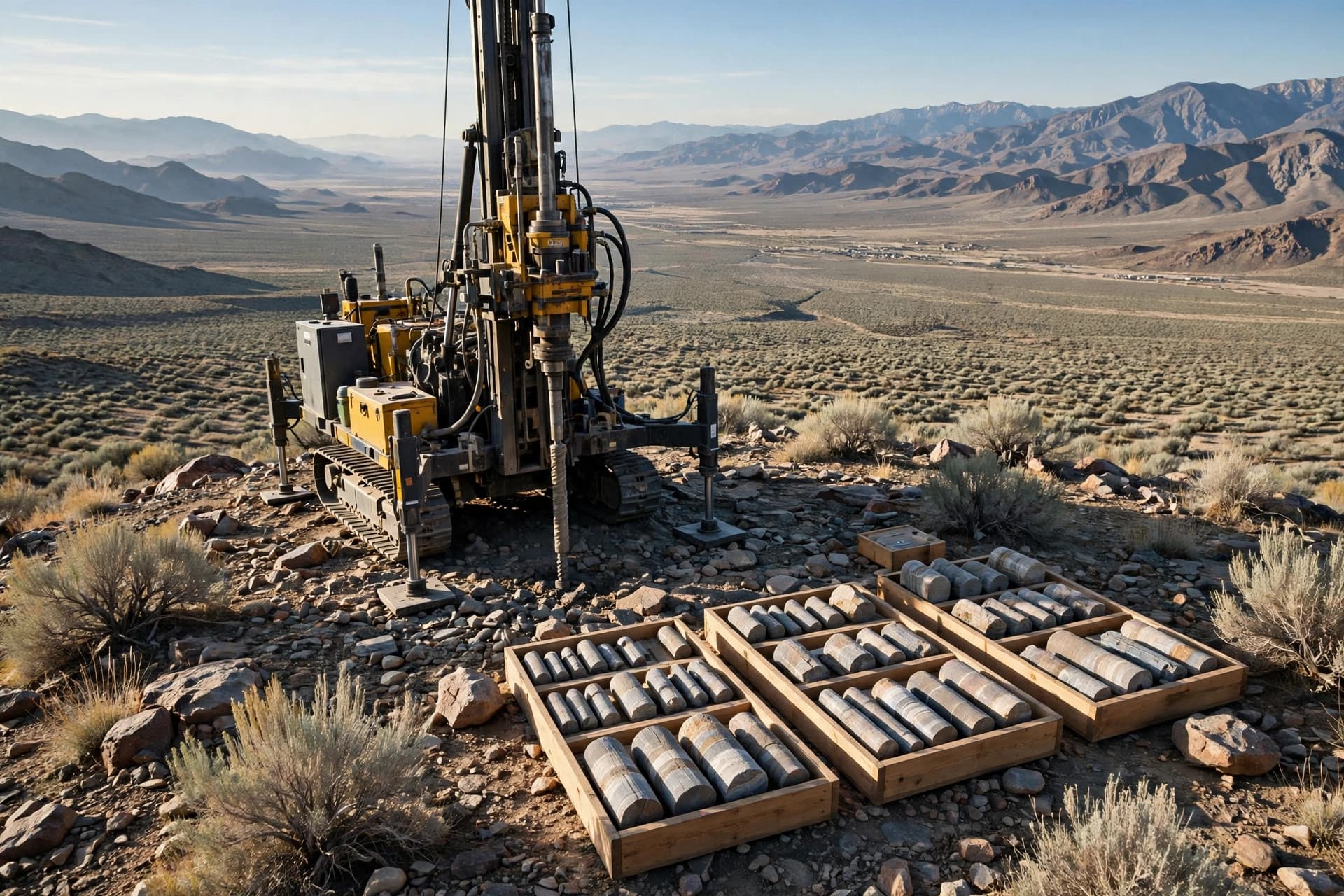
Phase 2 at Majuba Hill now has its first hole in the box — and the hole refused to stop where the plan said it would. Copper One Resources' October 30 update is a drilling-progress report, not a results report: what MHB-39 contains will be decided at the laboratory, not at the drill pad.
- First Phase 2 hole complete: MHB-39 reached a final depth of 1,460 feet (approximately 445 metres), the first completed hole of the up-to-10,000-foot (3,048-metre) Phase 2 diamond drilling program at the 100%-owned Majuba Hill copper-silver-gold project in Pershing County, Nevada.
- Deeper than planned: the hole was originally designed for 1,000 to 1,250 feet; persistent silicification led the technical team to extend it, finishing about 210 feet beyond the upper end of its original planned depth range.
- What was seen — visual only: native copper photographed at 1,090 feet (332 metres) and copper oxides at 820 feet (249 metres). The release states repeatedly that these are visual identifications, subject to laboratory confirmation, and are not a substitute for assay results.
- How it ended: at final depth the hole was in moderately silicified rhyolite containing stockwork tourmaline veinlets, with trace fine-grained pyrite and trace sphalerite — alteration geology that will be folded into the company's model to guide the next holes.
- Program shape: Phase 2 is HQ/PQ diamond core drilling; an initial approximately 5,000 feet is contracted to Evolve Exploration Nevada, running two shifts, 24 hours a day, seven days a week, with a maximum planned hole depth under the initial scope of about 1,700 feet.
- Still waiting on the lab — twice over: assay results from the completed 2026 Phase 1 program remain pending, and MHB-39 itself now goes through logging, sampling and laboratory analysis before any grades exist.
Why a hole gets extended
Drillers extend a hole when the rock at the bottom is still telling them something. Here, the stated reason was continued silicification — silica alteration of the kind that travels with the hydrothermal system Majuba Hill is exploring — so the team kept going another 210 feet past the planned top end rather than collar the next hole on a shallower picture. President and CEO David Greenway put it in process terms: completing MHB-39 beyond plan "provides our technical team with additional geological information as we advance Phase 2," and the visual secondary copper minerals and persistent silicification "warrant further evaluation through detailed logging, sampling and analysis."
The program's stated objective is systematic: test priority targets across the property and advance Majuba Hill toward a maiden mineral resource estimate prepared under NI 43-101. The project carries a deep historical database to build on — the release counts more than 95,000 feet (28,956 metres) drilled to date across more than 100 drill holes at this past-producing copper mine — on a property of approximately 9,684 acres (3,919 hectares), about 70 miles southwest of Winnemucca and 156 miles northeast of Reno, with year-round road access, nearby power and water.
The honesty box
There are no assay grades in this release — none. Native copper and copper oxides were visually identified in core, and the release itself warns that visual observations are preliminary, do not establish metal grades or economic significance, and may not be confirmed by the laboratory. Majuba Hill has no current NI 43-101 mineral resource estimate — a maiden resource is the program's objective, not an existing fact — so there is no compliant resource against which to judge what MHB-39 might mean. The 10,000-foot Phase 2 figure is an "up to" program size, with about 5,000 feet contracted in the initial scope; final collar locations and depths for later holes remain to be set by the technical team.
What to watch
The Phase 1 assays, still pending from the completed 2026 program; then MHB-39's own assay results once logging and sampling are done; and where Phase 2 collars its next holes as the silicification and tourmaline picture from this first hole is worked into the model.