
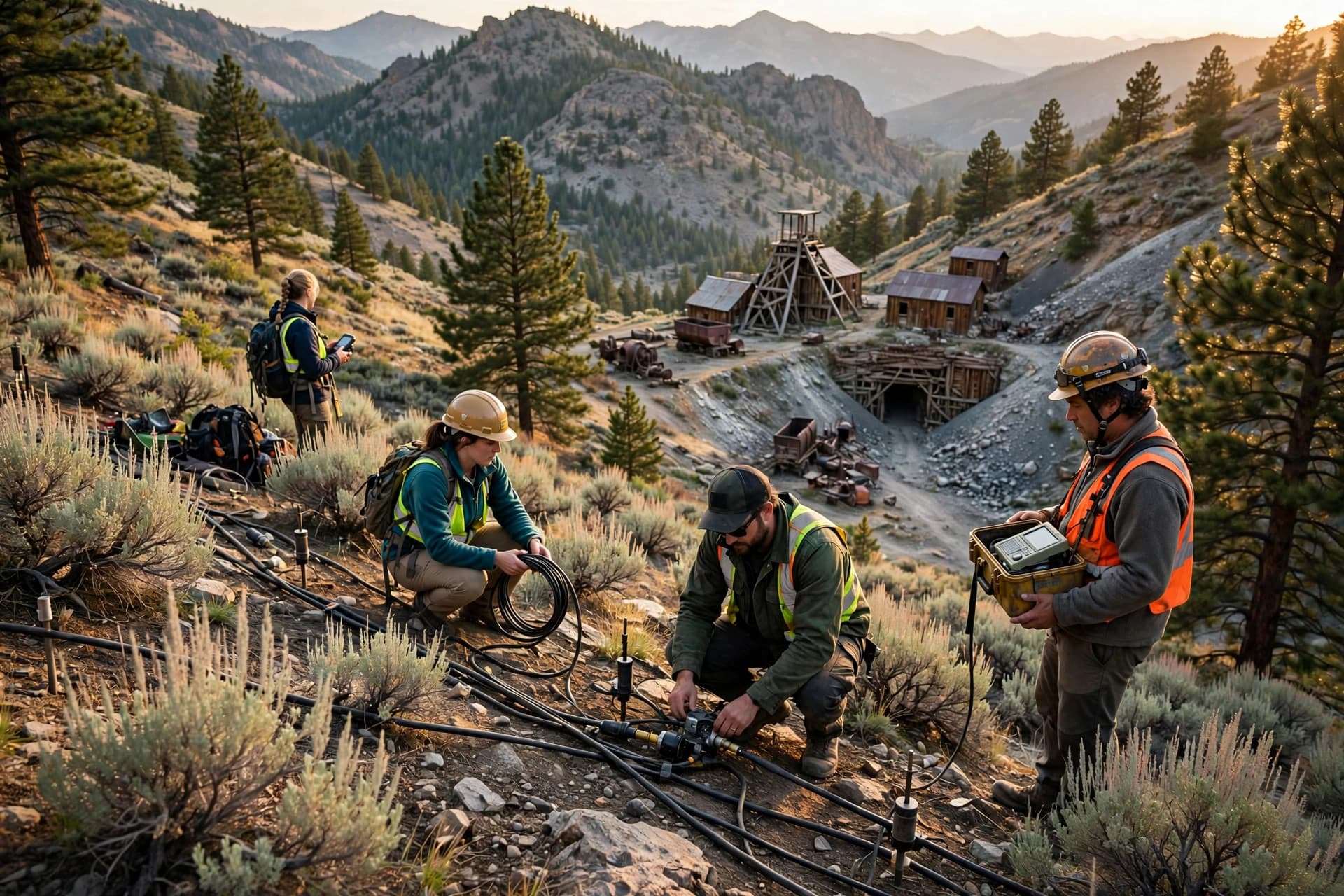
Clayton produced silver for half a century without ever being mapped with modern geophysics. That gap is closing. CMX Gold & Silver said on October 29 that its inaugural exploration program at the Clayton Silver Project, in the Bayhorse Mining District of central Idaho, is about two-thirds complete.
- The surveys: a combined 3D induced polarisation (3DIP) and magnetotelluric (MT) program by DIAS Geophysical, estimated about two-thirds complete over CMX's patented and unpatented claims.
- The new timeline: comprehensive results expected in early December 2026, with interpretation to follow and diamond drilling targeted for early 2027 to test priority targets.
- The ground: 1,028 acres — 29 patented mining claims and two patented mill sites (about 562 acres) plus 20 unpatented claims (about 466 acres), roughly 30–40 kilometres south-southwest of Challis. The patented claims carry surface ownership, no government royalties, and do not require drilling permits, the company says.
- What the surveys are for: delineating known veins and finding new ones, identifying extensions of partially mined ore bodies, and evaluating deeper sources of mineralisation.
- The early read — preliminary only: VP Exploration Rick Walker said preliminary evidence points to a potentially broader system of numerous veins and/or lenses in a network of fault-controlled veins, consistent with a carbonate replacement deposit model.
- Funding in progress: CMX is continuing a non-brokered private placement of $0.25 units (one share plus one warrant exercisable at $0.40 for two years), subject to CSE approval and a four-month-plus-one-day hold.
A mine that was never systematically explored
CEO Jan Alston's point was the absence underneath the history: with no historic geophysical work and no systematic exploration drilling to suggest potential beyond the old workings, this program "will provide the first model of the underground system of mineralization." The existing vein, he said, is open to depth and to the north.
The historic mine ran from 1935 to 1986 and was one of the most active underground mines in the district. Underground development reached eight levels to 1,100 feet, with nearly 19,700 feet of workings, and partially mined two tabular ore bodies known as the South and North Ore Bodies.
The honesty box
The production figure — approximately 7 million ounces of silver, together with lead, zinc, copper and minor gold, from an estimated 2.15 million tonnes of ore — is historical production, sourced in the release to a 1986 Eastern Washington University master's thesis, not a current resource. The release itself cautions that historical information referenced is not NI 43-101 compliant. The same label applies to the underground hit it cites: drill hole 1501-A intersected 22 feet of high-grade polymetallic mineralisation at about 1,425 feet, with true width not known — a historical intercept below the deepest workings, not a new drill result. There are no new drill assays, no current mineral resource and no discovery in this release; the "broader system" language is explicitly preliminary, ahead of final data and interpretation. The early-2027 drilling start is a stated goal, not a permitted, funded certainty, and the private placement is ongoing and subject to exchange approval.
What to watch
The early-December delivery of the combined 3DIP and MT results, the interpreted target list that follows, and whether CMX converts that model into a dated, funded diamond drill program for early 2027.