
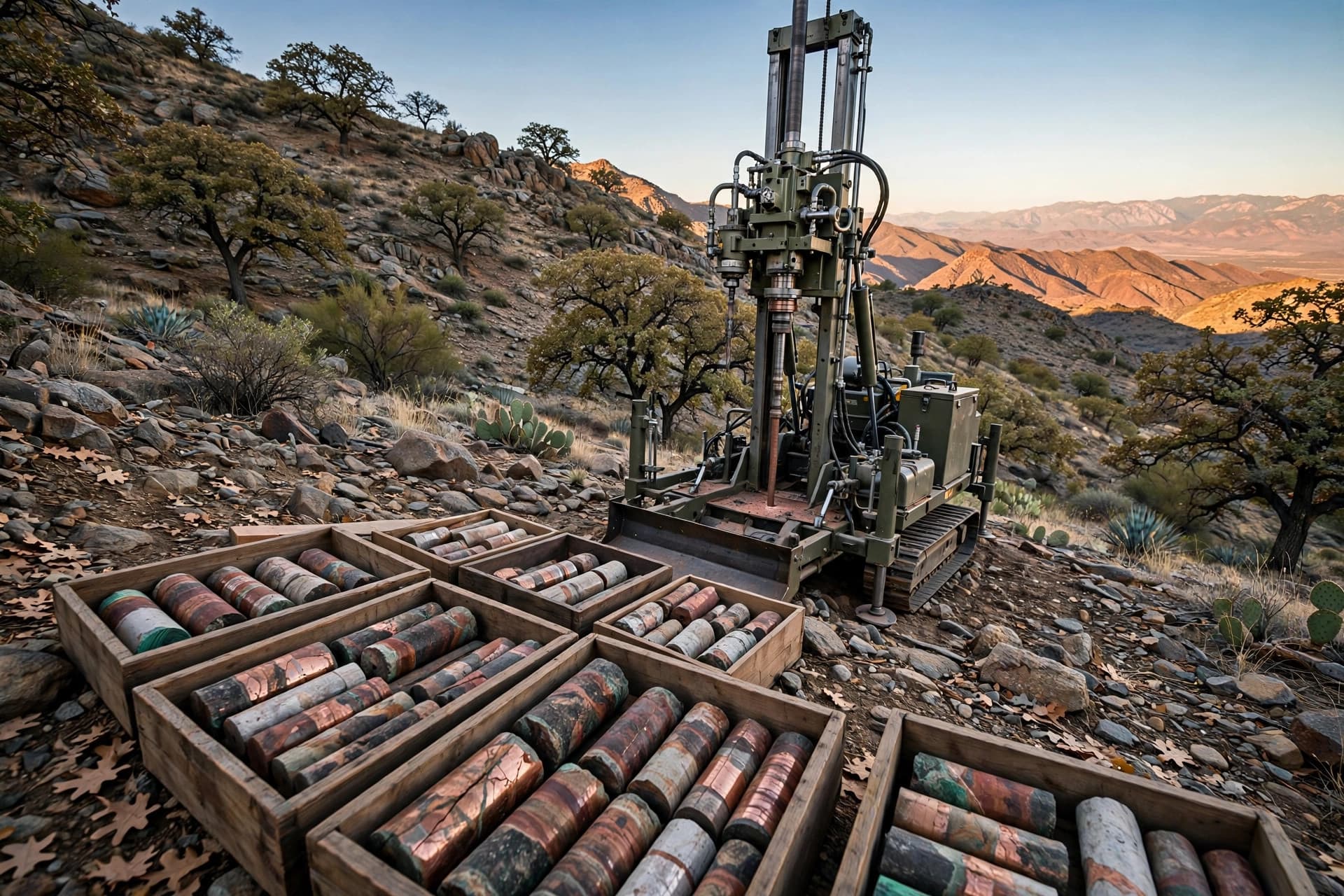
The spring rig found the copper. It just could not go deep enough to follow it. Barksdale Resources announced November 3 that diamond drilling began November 2 at Sunnyside, its 67.5%-owned copper-zinc-lead-silver project in the Patagonia mining district of southern Arizona — a switch from chips to core, and from the top 450 metres of the system to the porphyry underneath.
- The program: Phase 1 of a planned 16,000-metre diamond drill program — approximately 8,000 metres (about 26,250 feet) — now under way, funded from the company's recently completed C$15.7 million private placement.
- Why core: the spring and summer 2026 reverse-circulation program reached only about 450 metres; RC holes at the World's Fair and January-Norton targets stopped short of planned depth on heavy water inflows. Oriented diamond core is meant to reach the deeper targets and return continuous core for geological, structural and metallurgical work.
- What it is following up (2026 RC results first reported May 4, 2026; drilled lengths, true widths not known): SUN26-002R — 393.19 metres of 0.45% Cu from 3.05 metres, including 60.96 metres of 0.93% Cu and 60.96 metres of 0.90% Cu with 13.72 metres of 1.47% Cu at 302 metres; SUN26-001R — 39.62 metres of 0.95% Cu from 248.41 metres, including 12.19 metres of 1.45% Cu; SUN26-003R — 53.34 metres of 0.64% Cu from 7.62 metres, including 12.19 metres of 1.04% Cu.
- Permits: Phase 1 holes sit on drill sites already approved under the project's existing Plan of Operations with the U.S. Forest Service.
- Targeting help on the way: an airborne ZTEM survey over the Sunnyside and Four Metals properties is flown and in processing; final data is expected by early December 2026 to refine Phase 2 targets.
The depth problem, in the company's own telling
President and CEO Chris Stewart: "Our 2026 RC program confirmed broad, continuous copper mineralization at Sunnyside, but the rig could not reach the deeper parts of the system. With a core rig now on site and the Phase 1 drill program fully funded, we will test the high-grade copper at depth utilizing oriented core drilling so we can gather critical information about the lithology and structure of the rocks at Sunnyside."
That information matters because Sunnyside's shape at depth currently rests on old holes. Historical ASARCO hole TM-8 was drilled to 1,730 metres and found copper mineralization down to 1,689 metres, where sampling stopped — including 3.05 metres of 1.36% Cu at 491 metres. Barksdale holds the historical ASARCO core and is re-examining some of it, but the new core program is the first modern test designed to tie the near-surface RC intercepts to whatever the system does below 450 metres. Barksdale also holds the 100%-owned San Antonio copper project in the same Patagonia district, and the San Javier copper-gold project in Sonora, Mexico.
The honesty box
Everything drilled so far at Sunnyside is exploration, not a resource: the release reports no mineral resource or reserve for the project, and the RC intervals it recaps are drilled lengths with true widths unknown. The historical ASARCO data — TM-8 included — has not been verified by the Qualified Person: the original sampling, assay and QA/QC records are unavailable and the historical core has not yet been re-logged or re-sampled, so the release itself says that data is context only and should not be relied upon. The 2026 RC assays were verified by Qualified Person Alan Roberts, CPG, the company's Vice President, Exploration, who is not independent of the company. And a commenced program is a plan being executed, not a result — Phase 1 assays are the next real information.
What to watch
ZTEM final data in early December and the Phase 2 targets it produces; the first Phase 1 core assays and whether the high-grade intervals persist below the RC floor; and hole depths actually achieved against the water-inflow problems that stopped the RC rig.