
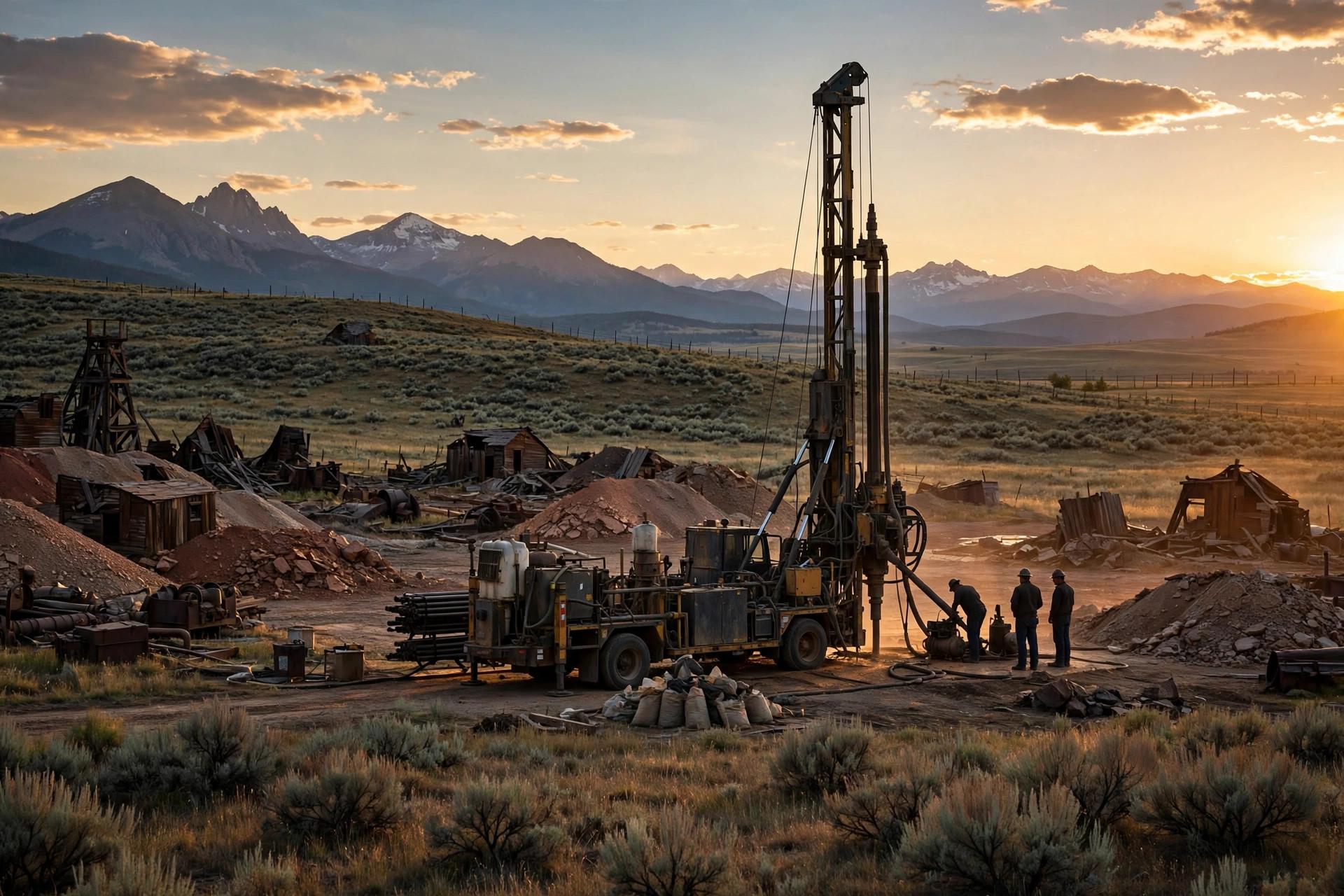
The Madison story has been a copper-gold story told around two historic mine areas. American Pacific Mining Corp.'s (CSE: USGD) (OTCQX: USGDF) November 5 results move the story outward: four exploration holes tested separate targets across the 100%-owned Madison Copper-Gold Project in Montana, some of them roughly 800 metres from the historic Madison and Broadway workings, and the gold showed up in every reverse-circulation hole.
- M26RC-01: 9.2 metres grading 3.74 g/t gold from 166.1 metres, including 4.6 metres at 7.02 g/t gold and 1.5 metres at 10.65 g/t gold with 0.11% copper. The hole cut several gold-bearing intervals between 146.3 and 239.2 metres, plus a separate shallow copper interval of 10.7 metres at 0.26% copper.
- M26RC-02: 15.2 metres grading 1.03 g/t gold from 120.4 metres, including 3.0 metres at 2.43 g/t gold.
- M26RC-03: near-surface gold — 3.0 metres grading 4.53 g/t gold from 15.2 metres, including 1.5 metres at 5.58 g/t gold, plus three additional 1.5-metre gold intervals.
- M26C-03 (core): no significant gold interval; narrow lead-zinc only, including 0.5 metres at 0.57% lead and 0.14% zinc.
- The program: the 2026 Madison campaign is the largest coordinated program the company has run at the project — approximately 15,000 metres of combined RC and diamond core drilling — designed to extend shallower high-grade copper-gold mineralization and test deeper porphyry targets. Further assays are pending.
- True widths have not been determined for the reported intervals; all are reported as down-hole sample lengths.
Separate targets, not one zone yet
The point of this round was breadth, not definition. Each hole tested a different target, and Managing Director of Exploration Eric Saderholm — the release's Qualified Person — was explicit about both the encouragement and the limit: "Intersecting gold in all three RC holes gives us additional evidence of mineralization beyond the historical workings and helps us sharpen our next drill targets. These are encouraging results, but further drilling is needed to establish their extent and continuity."
The new holes are deliberately distinct from Madison's September headline — hole M26C-02's 30.8 metres at 7.40 g/t gold, 9.62 g/t silver and 0.29% copper, previously reported in September and not part of this release. Follow-up drilling on the M26C-02 area is now under way, with results expected over the coming months.
The honesty box
These are four isolated exploration holes on separate targets — the results establish that gold mineralization exists well beyond the historic workings, not that the intercepts connect to each other or to the Madison mine, and the company says exactly that. True widths are unknown, grades are carried by narrow high-grade sub-intervals inside broader lower-grade envelopes, and the one core hole in the set returned no significant gold at all. There is no new resource estimate in this release; Madison's figures remain those of its existing NI 43-101 technical report.
What to watch
The follow-up results around M26C-02, where the September high-grade intercept is being drilled now; whether the distal RC targets get dedicated follow-up holes in the balance of the 15,000-metre program; and the pending assays from the holes already completed, which will show how much of the property outside the historic footprint is mineralized.