
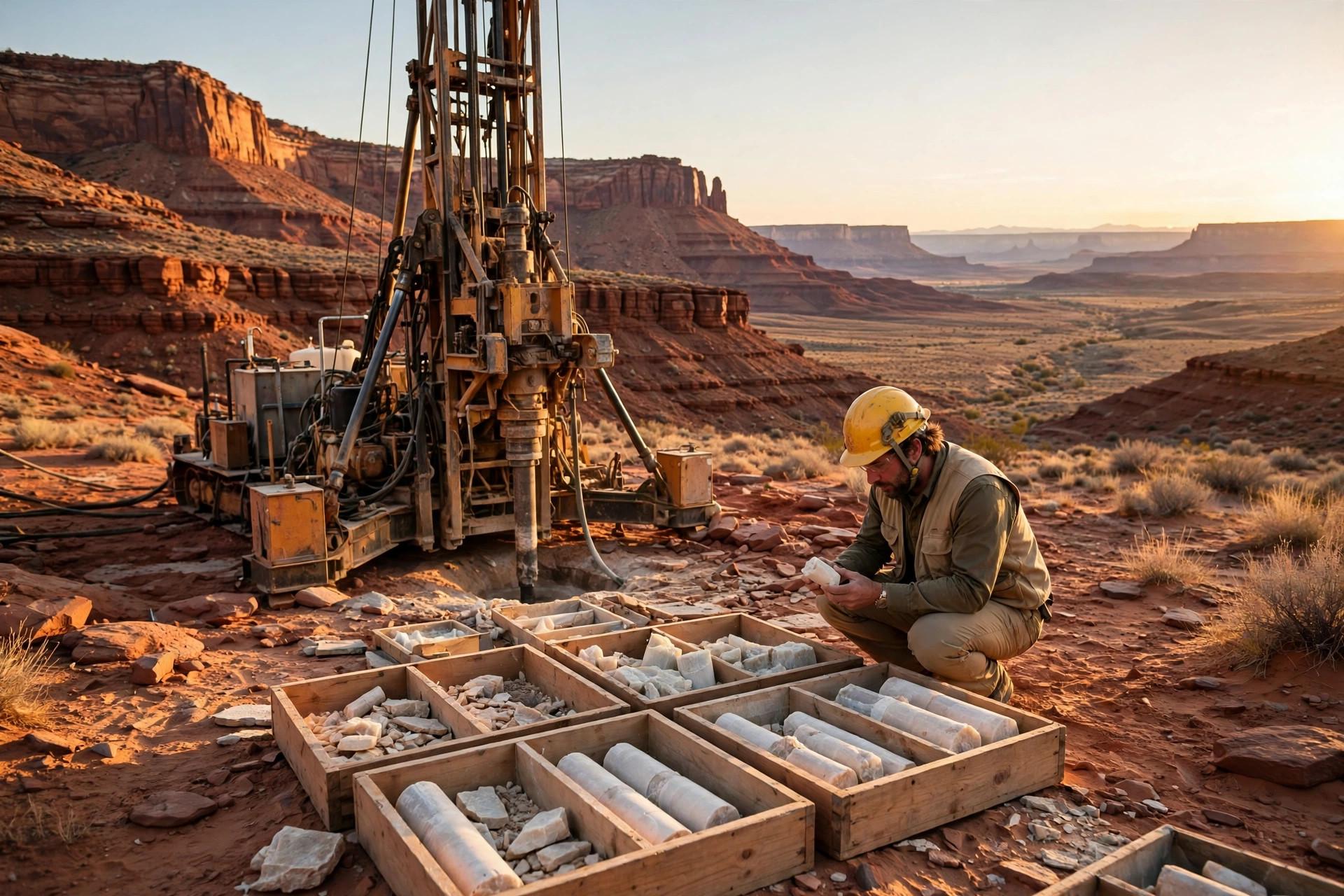
The first well American Critical Minerals has ever drilled at Green River came back thicker and richer than the historic well it was drilled to check. American Critical Minerals Corp. (CSE: KCLI) (OTCQB: APCOF) (Frankfurt: 2P3) announced on November 19 that it has received assay results from the Duma Point AP-S-02 well at its Green River Project, 20 miles northwest of Moab in Utah's Paradox Basin — and that the Cycle 5 potash member in that well grades materially higher than the same bed in the Quintana Fed 1-1 well drilled some 600 metres to the east-northeast.
- The headline intersection: assays and downhole wireline geophysical logs together returned a composite grade of 38.51 wt.% KCl over 6.55 metres (21.5 feet) within the Cycle 5 potash member.
- The high-grade core: within that interval, 42.94 wt.% KCl over 2.1 metres (about 7 feet).
- Assays alone: the recovered core by itself returned 35.4 wt.% KCl over 5.54 metres (18.17 feet) at a 5% K2O cut-off, with composite carnallite content under 0.1 wt.% and insolubles under 1.0 wt.%.
- Against history: the intersection is an 11% increase in thickness and a 51% increase in grade compared with the historic Quintana Fed 1-1 well, which reported 24.3% eKCl over 5.9 metres from e-logs.
- How the well was drilled: AP-S-02 reached a total depth of 2,818 metres (9,245 feet); coring of Cycle 5 began at 1,741 metres. Tight hole conditions limited core recovery to 25.25 metres of a planned 45.72-metre run, with 1.01 metres of the potash interval lost — that lost section's grade comes from the wireline logs, which the company says correlated strongly with the assays where both exist. The rig demobilized on September 25, 2026, and the well has been cemented and abandoned under its state permit.
- The lab: 21 halved core samples were analyzed at the Saskatchewan Research Council laboratories in Saskatoon, with blanks, standards and duplicates inserted.
- The ground: a 100% interest in 11 SITLA leases (~7,050 acres), 1,094 federal lithium brine claims (~21,150 acres) and 11 federal potash prospecting permits (~25,480 acres) — about 32,530 acres in total, with authorization to drill seven holes across the project.
- Next: planning for one to two additional wells begins now, aimed at generating an NI 43-101 compliant resource and a scoping study.
Why beating the historic hole matters
Green River's investment case has always rested on old data. The Paradox Basin's potash beds were mapped largely from oil and gas drilling, and the project's previously disclosed exploration target — 500 million to 950 million tonnes of sylvinite grading 12% to 18% K2O, on e-log estimates — is exactly that: a target, not a resource. AP-S-02 was drilled to validate that historic picture, and on the potash bed it did better than validate it. A modern, assayed intersection that runs 51% higher in grade and 11% thicker than the neighbouring historic e-log intercept gives the company a firmer anchor for the resource drilling it now plans, and it does so in the same Cycle 5 bed that feeds Intrepid Potash's Moab Solution Mine nearby — the operation of the United States' largest potash producer, working the same stratigraphy in the same basin.
The strategic backdrop is in the release itself: the United States imports more than 90% of its potash demand (USGS Mineral Commodity Summaries, January 2025), and in November 2025 the Department of the Interior added potash to the U.S. list of critical minerals.
The honesty box
Three cautions belong on the record. First, the headline 38.51% figure is a composite of assays and wireline e-log interpretation — 1.01 metres of the 6.55-metre interval was lost core, graded from logs rather than laboratory assays; the assay-only composite is 35.4% over 5.54 metres. Second, this is one well. It confirms high-grade sylvite at one location in Cycle 5; it does not establish continuity across 32,530 acres, and the project has no mineral resource estimate — the 500–950 million tonne figure remains an exploration target based on historic e-logs. Third, the well's second purpose came back largely empty: brine sampling for lithium and bromine produced no meaningful lithium or bromine results from the Leadville Formation test, and the Paradox Formation sample was contaminated with drilling fluid and deemed inconclusive. The company says it will re-evaluate future deep brine drilling given the cost of wells to these depths.
What to watch
Whether the planned one to two follow-up wells repeat Cycle 5 grades away from AP-S-02; the timeline to a first NI 43-101 resource and scoping study; and whether the lithium-bromine brine thesis — a large part of the project's original pitch — is revived with longer pumping tests or quietly set aside in favour of a potash-only story.