
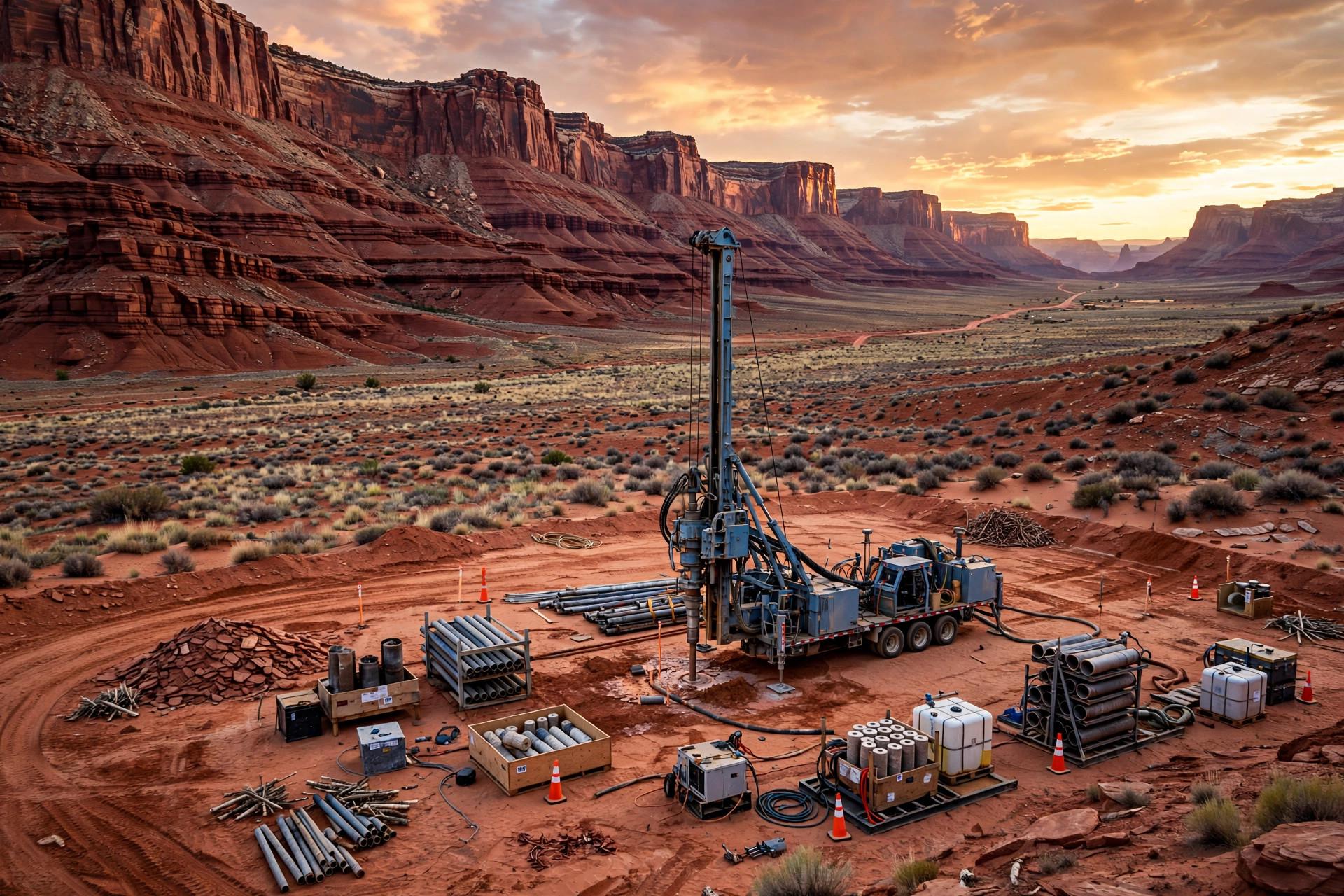
The paperwork is done; the next step at Lisbon Valley East is a drill bit. American Atomics Inc. (CSE: NUKE) (OTC: NUKUF) (FWB: Q3B) announced on November 17 that the Bureau of Land Management has approved its Notice of Intent ("NOI") for drilling at its Lisbon Valley East project in San Juan County, Utah, and that the company has posted the performance bond the approval required — clearing the way for the first modern drill test of a uranium belt that, on the company's interpretation, faulting dropped some 2,500 feet underground.
- The approval: BLM approval of the NOI for up to an initial 22 drill holes at Lisbon Valley East, in a series of multiple groupings — either a 3-hole triangular grouping surrounding an anomalous historic oil and gas drill hole, or a 3-to-4-hole fence drilled across the suspected belt.
- The bond: American Atomics has posted the required US$64,300 performance bond with the State of Utah, which the company describes as the last requirement prior to the commencement of drilling.
- The target: the strike length and width of a suspected arcuate belt of uranium mineralization lying at a depth of approximately 2,500 feet, on the down-faulted northeastern side of the Lisbon Valley anticline.
- The ground position: the company holds the right to acquire up to an 80% interest in the property through an option assignment agreement with Big Indian Prospectors LLC, as optionor, signed and previously announced on March 11, 2026.
- The historic district: the Big Indian District produced 78 million pounds of U3O8 at an average grade of approximately 0.37%, largely from an arcuate belt 1 mile wide by 16 miles long on the southwest limb of the faulted Lisbon Valley anticline. Individual orebodies ranged from a few hundred pounds to 20 million pounds of U3O8, hosted in the basal Moss Back member of the Triassic Chinle Formation.
- The QP: Tim Henneberry, P.Geo., a consultant to the company, reviewed and approved the technical information in the release.
The belt that faulting hid
Lisbon Valley's known uranium sits on the southwest side of the anticline. The geological argument for Lisbon Valley East is about the other side. On American Atomics' account, the northwest-trending, post-mineral Lisbon Valley normal fault abruptly cut off the mineralization associated with the northeastern flank and displaced it downward — speculatively, in the company's own word, by about 2,500 feet.
The evidence for a second, buried belt comes not from uranium drilling but from oil and gas wells. Drilling in the 2000s and early 2010s on the down-faulted northeastern side recorded anomalous to extremely anomalous gamma ray readings in the suspected Moss Back member in 28 of 51 holes, spread across a northwestern-trending belt 12.4 miles long by 1.2 miles wide — dimensions comparable to the historic producing belt on the southwest limb. The 22 approved holes are designed to test whether that gamma signature is a real, continuous uranium belt at depth, starting with triangular groupings around individual anomalous oil and gas holes and fences across the belt's interpreted width.
That is a genuinely binary exploration proposition: either the Moss Back on the northeast side carries uranium mineralization comparable to the district's historic production, or the gamma anomalies do not convert into uranium grades in core. The NOI approval and bond do not answer that question — they authorize the drilling that can.
The honesty box
Everything geological in this story is historical and unverified. American Atomics states plainly in the release that the data disclosed relates to historical exploration, that it has not undertaken any independent investigation of the sampling and has not independently analyzed the historical results, and that it intends to use the data only as a guide for its own programs, with verification to come through its own drilling. Gamma ray readings in oil and gas wells are a radioactivity measurement, not a uranium assay — they can reflect other radioactive elements and do not establish grade, thickness or continuity. The 78-million-pound, 0.37% figure is historic production from the district's southwest belt, cited from a 1990 Utah Geological and Mineral Survey summary — it describes what was mined elsewhere in the district, not a resource of any kind at Lisbon Valley East, which has no mineral resource estimate. The 2,500-foot displacement is the company's interpretation, described in its own release as speculative. Drilling to roughly 2,500 feet is also materially more expensive per hole than shallow exploration, which is why the grouping-by-grouping approval structure matters.
What to watch
A drilling start date and contractor for the first grouping; which anomalous oil and gas holes the first triangular groupings target; and, in due course, the first modern assay results from the Moss Back on the northeastern side of the anticline — the first hard data point in the Lisbon Valley East thesis.