
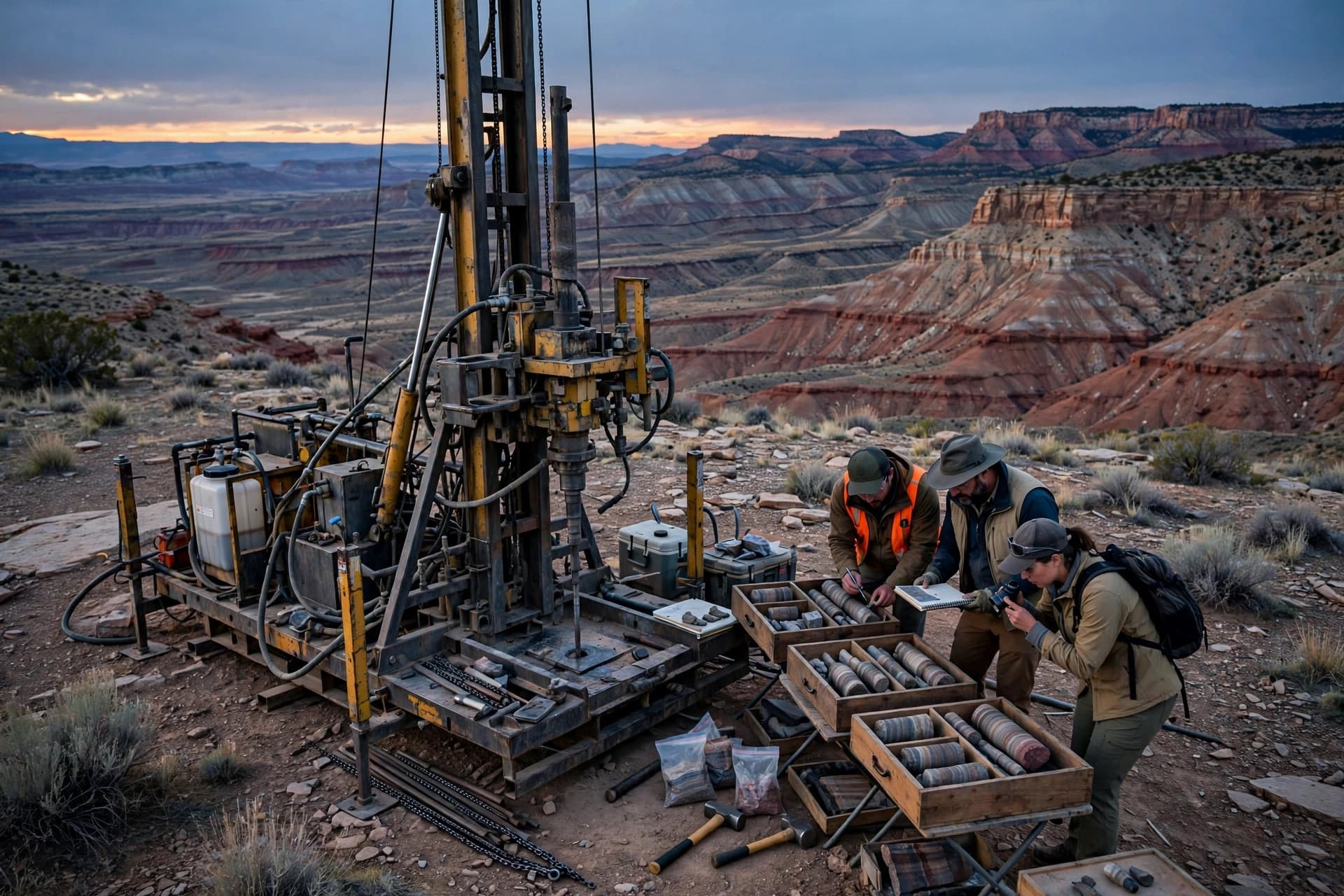
Deep drilling under Utah's basin cover is slow, expensive, and easy to get wrong — which is why completing the hole at all is part of this story. On October 15, BCM Resources reported that diamond hole TK21 at its Thompson Knolls project in Millard County reached its full depth and passed through a long stretch of copper-bearing skarn.
- TK21 is a vertical hole finished at 4,241 ft (1,293 m), drilled from the same platform as earlier hole TK5, which had been lost to difficult conditions after cutting copper skarn at about 2,758 ft.
- Logging recorded mineralized copper skarn over roughly 1,000 ft (304.8 m) downhole, with a sub-interval of about 460 ft (140 m) carrying chalcopyrite estimated at more than 1% by volume.
- Bedrock began at 1,867 ft (569 m) beneath fanglomerate cover — brecciated, limonitized limestone passing down into dolomite and dolomitic marble.
- BCM says TK21 resembles the skarn seen in TK5 and TK8 to the west, and reads it as a sign the hole is near the proximal skarn environment.
- A geophysical survey over the project is complete; the data is being processed into 3D models to design the upcoming Phase 5 drill program.
Why the geometry matters
Thompson Knolls is a covered target: hundreds of metres of basin fill sit on top of the carbonate rocks that host the skarn. Every hole therefore tests both the geology and the targeting model. TK21's value, on BCM's account, is that the mineralized interval lines up with what TK5 and TK8 found — consistency across holes is what turns isolated skarn sightings into a system worth following toward its source.
The honesty box
Everything reported for TK21 so far is visual logging. Chalcopyrite seen in core is not a grade; no TK21 assays have been published, and BCM's own commentary says grades await assay confirmation. A volume estimate of a mineral in core cannot be converted into a copper percentage, a resource, or a mine plan. The pending assays — and whether Phase 5 holes repeat the skarn with numbers attached — are the real test.
What to watch
The TK21 assay release, and the Phase 5 drill plan once the geophysical models are finished: where BCM points the next holes will show how much confidence it has in the proximal-skarn reading.